

The reality
Agriculture is the most dangerous industry in Australia.
Not one of the most dangerous — the most. These are the numbers behind every Australian farm.
Figures are for Australian agriculture as a whole — the industry this sector belongs to. See sources below.
The cattle problem
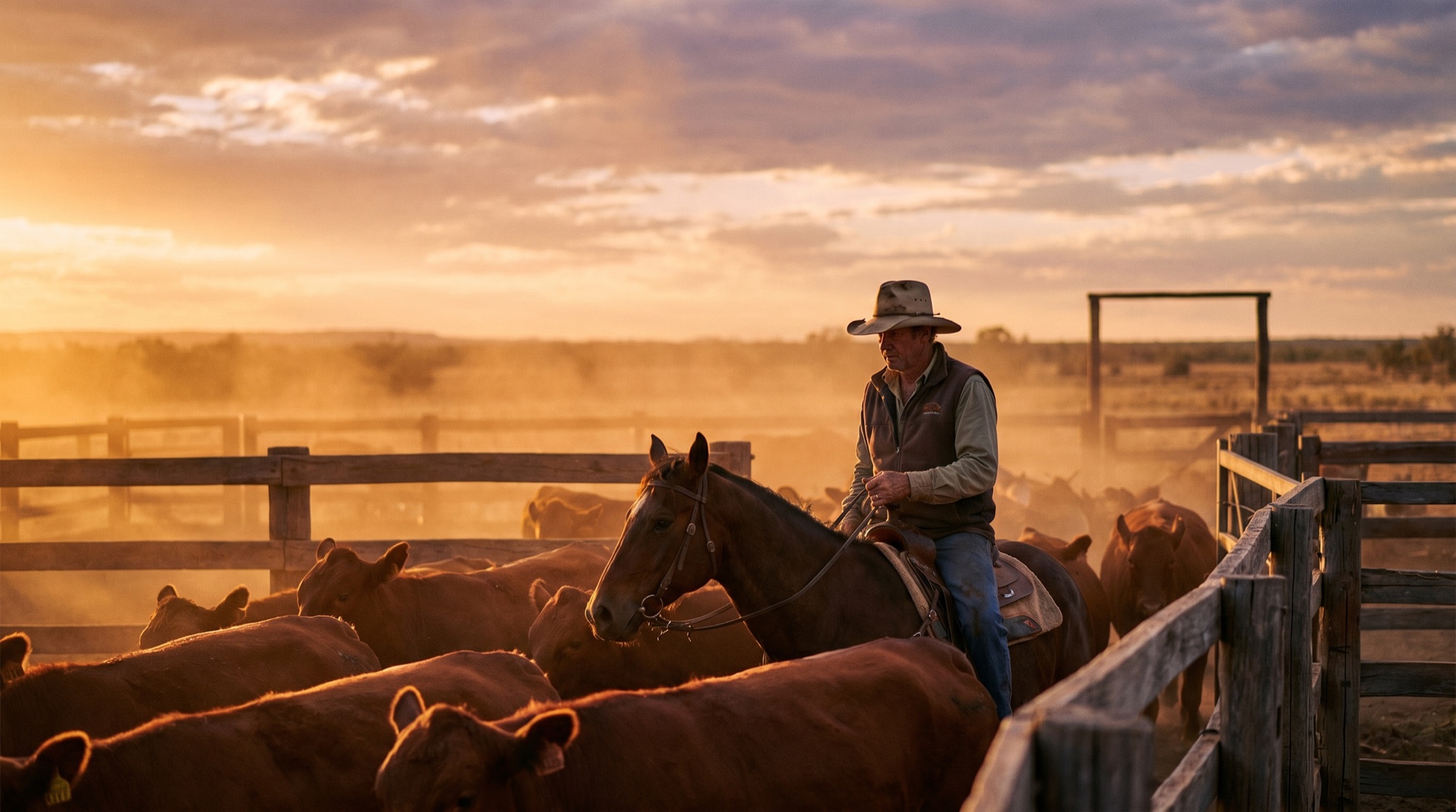
Cattle, horses and country don't forgive a mistake.
Mustering, drafting, calving and loading put people within reach of half a tonne of unpredictable animal — often on a bike or horse, often kilometres from the homestead. Most operations can't see where their people are, let alone whether they're safe.
01
Animals
Animals are among the leading agents of farm injury. A 20-year review of animal-related farm deaths found horses involved in 81% of cases and cattle the next highest3 — with crush, kick, trample and goring injuries common in the yards.4
02
Vehicles & rollovers
Side-by-sides, quad bikes and motorbikes are a leading cause of farm death; most serious incidents are rollovers, collisions and run-overs.5
03
Distance & isolation
Mustering and stockwork happen far from help and often out of phone range. Minutes matter after a fall or crush — and no one can respond to an incident they can't see.5
AirAgri for cattle – breeding
Real-time safety intelligence for every worker.
Live visibility of every rider, ringer and vehicle — and an alarm that doesn't need a hand free to press.
Real-time worker tracking
See where every worker is — across paddocks, yards and sheds, even out of phone range, direct-to-satellite.
Man-down & duress alarms
A fall, no-movement or duress alerts the closest people for immediate response. No button to remember.
Heat & isolation awareness
Flag heat conditions and lone or at-risk workers before exposure becomes an incident.
Fast inductions & training
Get seasonal, casual and contractor crews competent and recorded quickly, with SOPs that are easy to follow.
Hazard & incident reporting
Capture near-misses and hazards from the field, with a full, time-stamped audit trail.
ESG & board-ready data
Property- and role-based risk profiling, and defensible human-risk data for governance and ESG reporting.
The commercial upside
Safety that protects your people and your balance sheet.
The same system that brings workers home also lowers the cost of running the operation.
Fewer serious incidents
Faster response and earlier intervention reduce the events that hurt people and stop work.
Lower insurance & downtime risk
Fewer claims, less lost time, and a clear safety record at renewal.
Stronger governance narrative
Demonstrable duty of care across every site, role and contractor.
Audit-ready human-risk data
One source of truth for ESG, board and regulator reporting.
Designed for
Built for the way you work.
Beef is one of Australia's largest agricultural industries, part of an $88 billion sector.6
Bringing farmers home
See AirAgri across your operation.
Book a 30-minute walkthrough, or call us — we'll show you how it works for an operation like yours.
Thanks — we'll be in touch within two business days. Need us sooner? Call 1800 404 694.
Sources
- Safe Work Australia, Key Work Health and Safety Statistics 2024 — agriculture, forestry & fishing recorded the highest worker fatality rate of any Australian industry (13.7 per 100,000 workers). www.safeworkaustralia.gov.au
- AgHealth Australia (University of Sydney) and Farmsafe Australia, Safer Farms Report 2025 — 72 people were killed on Australian farms in 2024, the highest toll in more than two decades — roughly one death every five days — and more than double 2023 (against a five-year average of 53). Side-by-side vehicles (14 deaths, up from 4 in 2023) overtook quad bikes (10) and tractors (8) as the leading cause for the first time, and children under 15 were involved in 11% of fatal incidents. AgHealth's preliminary 2025 data records 171 serious on-farm injuries — already more than the 133 recorded in all of 2024. www.farmsafe.org.au
- Better Health Channel (Victoria), Farm safety — handling animals, and AgHealth Australia — animals are among the leading agents of farm injury; a 20-year review of animal-related farm deaths found horses involved in 81% of cases and cattle the next highest. www.betterhealth.vic.gov.au
- WorkSafe Queensland, Cattle handling — cattle handling causes crush, kick, trample and goring injuries and fatalities. www.worksafe.qld.gov.au
- AgHealth Australia and Farmsafe Australia, Safer Farms Report 2025 — farm vehicles are the leading cause of on-farm death: side-by-side vehicles, quad bikes and tractors together accounted for 32 of the 72 deaths in 2024, with fatigue, complacency and time pressure among the top contributing factors. www.farmsafe.org.au
- ABARES, Agricultural Commodities Report, December 2024 — the gross value of Australian agricultural production is forecast at $88.4 billion in 2024–25 (wheat alone $10.7 billion). www.agriculture.gov.au