

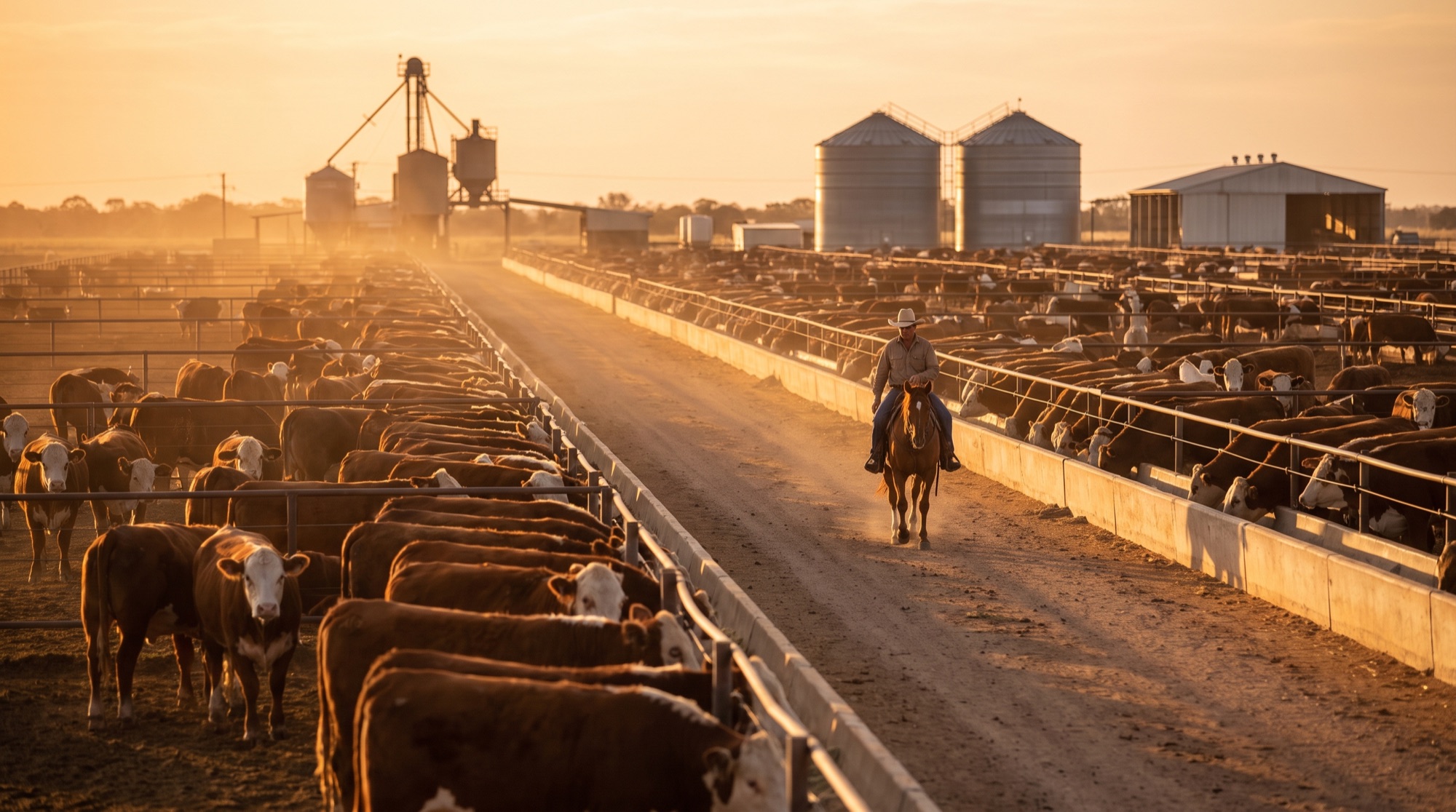
The reality
Agriculture is the most dangerous industry in Australia.
Not one of the most dangerous — the most. These are the numbers behind every Australian farm.
Figures are for Australian agriculture as a whole — the industry this sector belongs to. See sources below.
The cattle problem
A feedlot never stops — and every zone has its own risk.
From the pens to the mill, the hospital and the wash-down bays, work runs across the site around the clock, with staff, contractors and trucks constantly on the move. Each area carries its own hazards, and a worker alone in a back pen or up a mill can be a long way from help.
01
Pen riding
Pen riders spend the day alone on horseback or bikes among thousands of cattle, checking for sick and injured animals — with crush, kick and fall injuries an ever-present risk3, and a rider down in a back pen a long way from being found.4
02
Mill & feed operations
The feed mill runs augers, conveyors, hammer mills and elevators around grain dust and enclosed silos — entanglement, dust-explosion and engulfment are constant risks, and isolation is critical before anyone clears a blockage.5
03
Manure & effluent
Manure harvesting, stockpiles and effluent ponds bring loader work on soft piles and hydrogen-sulphide and oxygen-displacing gases — confined-space rules apply around pits and enclosed effluent systems.6
04
Maintenance
Repairs on mills, pens, water and machinery mean working at height, around stored energy and alongside contractors — and machinery is the leading cause of death on Australian farms, most often when equipment isn't isolated first.2
05
Inductions
Feedlots run large, changing crews of staff, contractors and truck drivers — getting everyone inducted, competent and biosecurity-cleared before they're on-site is a constant, high-volume duty that sits with the business.7
06
Hospital pens
Treating sick and injured cattle means close handling of stressed animals and veterinary chemicals, with real crush, kick and zoonotic-disease risk — often done alone in the hospital and receival areas.3
07
Wash-down bays
High-pressure washing of vehicles, trucks and equipment brings slips, chemical exposure and effluent around water — a routine biosecurity task whose risk sits squarely with the operator.7
AirAgri for cattle – finishing (feedlots)
Real-time safety intelligence for every worker.
One live view of every worker across the pens, the mill and the yards — with man-down alarms, fast inductions, digital SOPs and a clear audit trail built in.
Real-time worker tracking
See where every worker is — across paddocks, yards and sheds, even out of phone range, direct-to-satellite.
Man-down & duress alarms
A fall, no-movement or duress alerts the closest people for immediate response. No button to remember.
Heat & isolation awareness
Flag heat conditions and lone or at-risk workers before exposure becomes an incident.
Fast inductions & training
Get seasonal, casual and contractor crews competent and recorded quickly, with SOPs that are easy to follow.
Hazard & incident reporting
Capture near-misses and hazards from the field, with a full, time-stamped audit trail.
ESG & board-ready data
Property- and role-based risk profiling, and defensible human-risk data for governance and ESG reporting.
The commercial upside
Safety that protects your people and your balance sheet.
The same system that brings workers home also lowers the cost of running the operation.
Fewer serious incidents
Faster response and earlier intervention reduce the events that hurt people and stop work.
Lower insurance & downtime risk
Fewer claims, less lost time, and a clear safety record at renewal.
Stronger governance narrative
Demonstrable duty of care across every site, role and contractor.
Audit-ready human-risk data
One source of truth for ESG, board and regulator reporting.
Designed for
Built for the way you work.
Cattle finishing and feedlots are a major part of Australia's beef industry, within an $88 billion agricultural sector.8
Bringing farmers home
See AirAgri across your operation.
Book a 30-minute walkthrough, or call us — we'll show you how it works for an operation like yours.
Thanks — we'll be in touch within two business days. Need us sooner? Call 1800 404 694.
Sources
- Safe Work Australia, Key Work Health and Safety Statistics 2024 — agriculture, forestry & fishing recorded the highest worker fatality rate of any Australian industry (13.7 per 100,000 workers). www.safeworkaustralia.gov.au
- AgHealth Australia (University of Sydney) and Farmsafe Australia, Safer Farms Report 2025 — 72 people were killed on Australian farms in 2024, the highest toll in more than two decades — roughly one death every five days — and more than double 2023 (against a five-year average of 53). Side-by-side vehicles (14 deaths, up from 4 in 2023) overtook quad bikes (10) and tractors (8) as the leading cause for the first time, and children under 15 were involved in 11% of fatal incidents. AgHealth's preliminary 2025 data records 171 serious on-farm injuries — already more than the 133 recorded in all of 2024. www.farmsafe.org.au
- WorkSafe Queensland, Cattle handling — cattle handling causes crush, kick, trample and goring injuries and fatalities. www.worksafe.qld.gov.au
- AgHealth Australia and Farmsafe Australia, Safer Farms Report 2025 — farm vehicles are the leading cause of on-farm death: side-by-side vehicles, quad bikes and tractors together accounted for 32 of the 72 deaths in 2024, with fatigue, complacency and time pressure among the top contributing factors. www.farmsafe.org.au
- AgHealth Australia, Grain Handling Safety: A Practical Guide, and SafeWork NSW, Silo safety — an estimated 60 people are seriously injured each year on Australian farms using grain augers; silos carry fall, engulfment, dust-explosion and toxic-gas risks. www.safework.nsw.gov.au
- Better Health Channel (Victoria), Farm safety — confined spaces — manure pits and effluent systems generate hydrogen sulphide and other gases that displace oxygen; entry to confined spaces without ventilation has caused fatalities. www.betterhealth.vic.gov.au
- Fair Work Ombudsman, Horticulture Showcase: Workplace health & safety — WHS law sets no fixed stop-work temperature; the duty to assess and manage heat and chemical risk sits with the business. horticulture.fairwork.gov.au
- ABARES, Agricultural Commodities Report, December 2024 — the gross value of Australian agricultural production is forecast at $88.4 billion in 2024–25 (wheat alone $10.7 billion). www.agriculture.gov.au